

Volume 12, Issue 2 (Spring 2025)
JROS 2025, 12(2): 75-82 |
Back to browse issues page




Download citation:
BibTeX | RIS | EndNote | Medlars | ProCite | Reference Manager | RefWorks
Send citation to:


BibTeX | RIS | EndNote | Medlars | ProCite | Reference Manager | RefWorks
Send citation to:
Taghizadeh Kerman M, Ebrahimi Atri A, farahati S. Lower Extremities and Trunk Kinematic Asymmetry During Single-leg Landing in Preadolescent Female Soccer Players. JROS 2025; 12 (2) :75-82
URL: http://jros.iums.ac.ir/article-1-2300-en.html
URL: http://jros.iums.ac.ir/article-1-2300-en.html


1- Department of Sport Sciences, Faculty of Humanities, Sadjad University, Mashhad, Iran.
2- Department of Exercise Physiology, Faculty of Sport Sciences, Ferdowsi University of Mashhad,Mashhad, Iran.
2- Department of Exercise Physiology, Faculty of Sport Sciences, Ferdowsi University of Mashhad,Mashhad, Iran.
Full-Text [PDF 664 kb]
(141 Downloads)
| Abstract (HTML) (424 Views)
Full-Text: (128 Views)
Introduction
Anterior cruciate ligament (ACL) tears are known as one of the most devastating injuries in sports, such as soccer, basketball, and volleyball; they result from both contact and non-contact situations and affect athletes’ skill and life quality [1]. Most of these injuries occur with improper neuromuscular control during jumping and landing tasks [2]. Read et al. found that single-leg countermovement jump peak landing force asymmetry is the main risk factor for lower extremity injury [3]. Regarding kinetic and kinematic variables during jump landing tasks, limb asymmetry has been applied as a screening method and as a focus in rehabilitation after injury [4]. The asymmetry phenomenon may contribute to a non-contact ACL injury among female athletes [5]. Siebers et al. compared three symmetry indices for hip, knee, and ankle flexion angles during walking, ascending, and descending stairs, and reported that there was acceptable agreement between the three indices [6]. The proposed methods are beneficial for further symmetry analysis, as they take into account within-subject differences between sides and are not affected by the mitigating effects of averaging. One of these methods for symmetry analysis, validated by Gouwanda and Senanayake, is the normalized symmetry index (SI norm) [7]. Some studies have examined asymmetry of the lower limbs in bilateral landing tasks, including forward jump, stop-jump, and double-leg landings [5, 8]. Niu et al. reported that the dominant leg in healthy adults may be at greater risk of injury than the contralateral leg because of asymmetry in muscle activation and ground reaction force during double-leg landing [9]. In another study, the dominant lower extremity exhibited significantly lower knee flexion and hip flexion at initial contact and greater knee external rotation and hip external rotation at peak vertical ground reaction force compared to non-dominant leg, which has been associated with injury [8]. However, during single-leg landings, female soccer players demonstrated smaller range of motion for the knee and hip joints and larger medial and lateral center of pressure displacements in the non-dominant leg compared to the dominant leg, indicating that the non-dominant limb could be more susceptible to injury [10].
The current literature has not reached a consensus regarding which side presents higher kinematic risk for ACL injuries. Rossler et al. confirmed this view by following football players aged 7 to 12 over two seasons in the Czech Republic and Switzerland. The characteristics of injuries in child soccer players are different from those in soccer players of other age groups. For example, 60-90% of sports injuries in children are in the lower extremities [11]. Given that preadolescent girls are still developing their optimal movement pattern and that inter-limb symmetry is important in sport injury prevention, assessing kinematical differences between limbs (directly and using a symmetry index) may provide valuable insights into injuries in this population. Therefore, the purpose of this study was to investigate asymmetry of lower extremities and trunk kinematics during single-leg landing in preadolescent female soccer players.
Methods
Participants
Thirty-six preadolescent female soccer players (mean age: 11.2±1.1 years, height: 148.4±5.4 cm, weight: 40.9±3.5 kg) voluntarily participated in the study. Inclusion criteria were healthy participants aged 10 to 12 years, who played football two times per week for at least six months. Exclusion criteria included history of lower extremity and trunk injuries, ACL injuries or surgery within the past 6 months, and impaired balance. All testing procedures were explained to the participants, and the consent of a parent or guardian was obtained.
Procedure
Kinematic data were collected at 200 Hz with an 8-camera motion capture system (Qualisys; Goteborg, Sweden) positioned around a calibrated test area. A total of 45 markers were placed on the spinous process of C7 and T10, shoulders, scapula inferior angles, sacrum, anterior and posterior superior iliac spines, iliac crests, greater trochanters, lateral and medial knee epicondyles, lateral and medial malleoli, the first and fifth metatarsal heads, and heels. Four clusters composed of 4 markers each were placed on the thigh and shank (Figure 1) [12]. After warming up on a stationary bicycle for 5 minutes, participants were familiarized with the testing procedure by practicing the task three times prior to recording. Participants were instructed to stand on their non-dominant leg with arms crossed in front of their chest and then drop from a 30-cm high box, landing on the ground with the dominant leg [12]. The same protocol was adopted for the non-dominant landing trials. Three successful trials of the single-leg drop landing were collected for each limb with a 30-s rest between trials. A successful trial was considered when participants maintained their balance for at least 3 seconds after landing. The dominant leg was defined as the leg predominantly used to kick a ball [13].

Analysis of recordings
The analyzed landing phase was defined as the interval between the initial contact and peak knee flexion. Initial contact was defined as the moment when markers on the metatarsal heads reached their lowest position. The peak trunk, hip, and knee angles in the sagittal, frontal, and transversal planes during the landing phase were extracted. The position of three-dimensional markers was digitized using Qualisys Track Manager (version 2.2, Qualisys AB, Gothenburg, Sweden), and subsequently analyzed using Visual 3D (C Motion, USA). Data were filtered with a fourth-order zero-lag Butterworth 12 Hz low-pass filter before calculating the dependent variables. Joint angles were calculated using an X-Y-Z Cardan rotation sequence corresponding to the anteroposterior, mediolateral, and vertical axes, respectively [14]. The positive angles indicate knee flexion, knee adduction, knee internal rotation, hip flexion, hip adduction, hip internal rotation, trunk flexion, lateral trunk flexion, and trunk rotation toward the contralateral leg.
Statistical analysis
The Mean±SD were estimated for kinematical variables. The Shapiro-Wilk test indicated a normal distribution of the data. Therefore, paired t-tests were used to compare lower limbs and trunk kinematic variables during landing between dominant and non-dominant limbs, using SPSS software, version 25 (SPSS, Inc., Chicago, IL, USA). The statistical significance was set at P≤0.05. In addition, In addition, the effect size was estimated with Cohen’s d and interpreted as follows: d≥0.20 small, d≥0.50 medium, and d≥0.80 large [15]. For each subject, the normalized symmetry index (SI norm) was also used to analyze the symmetry of the trunk and lower extremities between the dominant and non-dominant legs by calculating Xnorm for both dominant and non-dominant limbs (Equation 1) [7]. D refers to the dominant limb, while N denotes the non-dominant limb.

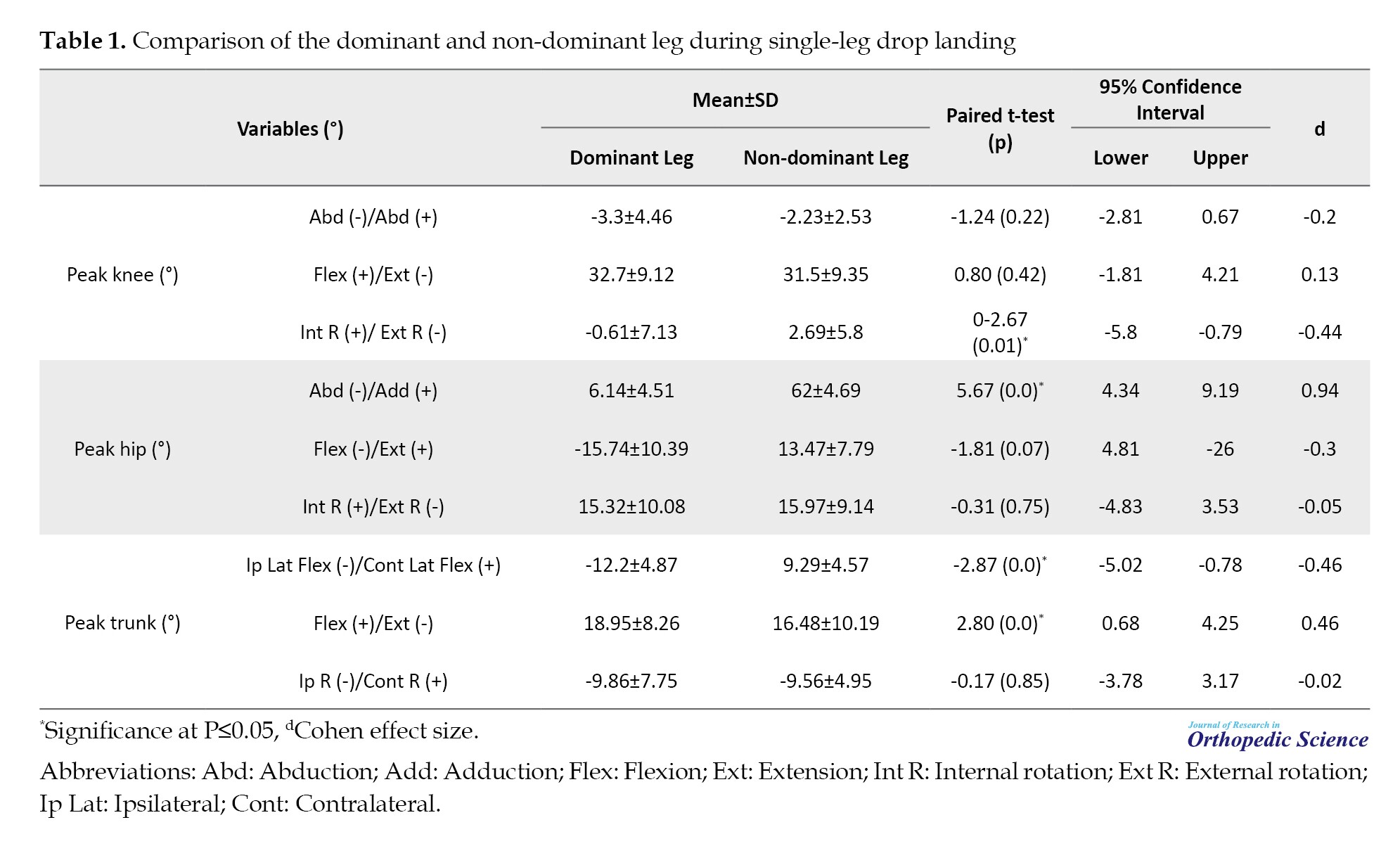
We found that the dominant leg exhibited significantly greater adduction compared to the non-dominant leg, with a large effect size (p=0.00, d=0.94). During landing with the dominant limb, knee external rotation was observed, while during non-dominant limb landing, knee internal rotation was found (p=0.01, d=-0.44). Additionally, the subjects exhibited larger peak trunk lateral flexion toward the ipsilateral side (p=0.00, d=-0.46) and trunk flexion angles (p=0.00, d=0.46) during landing on the dominant side compared to the non-dominant side, with a small effect size (Table 1).
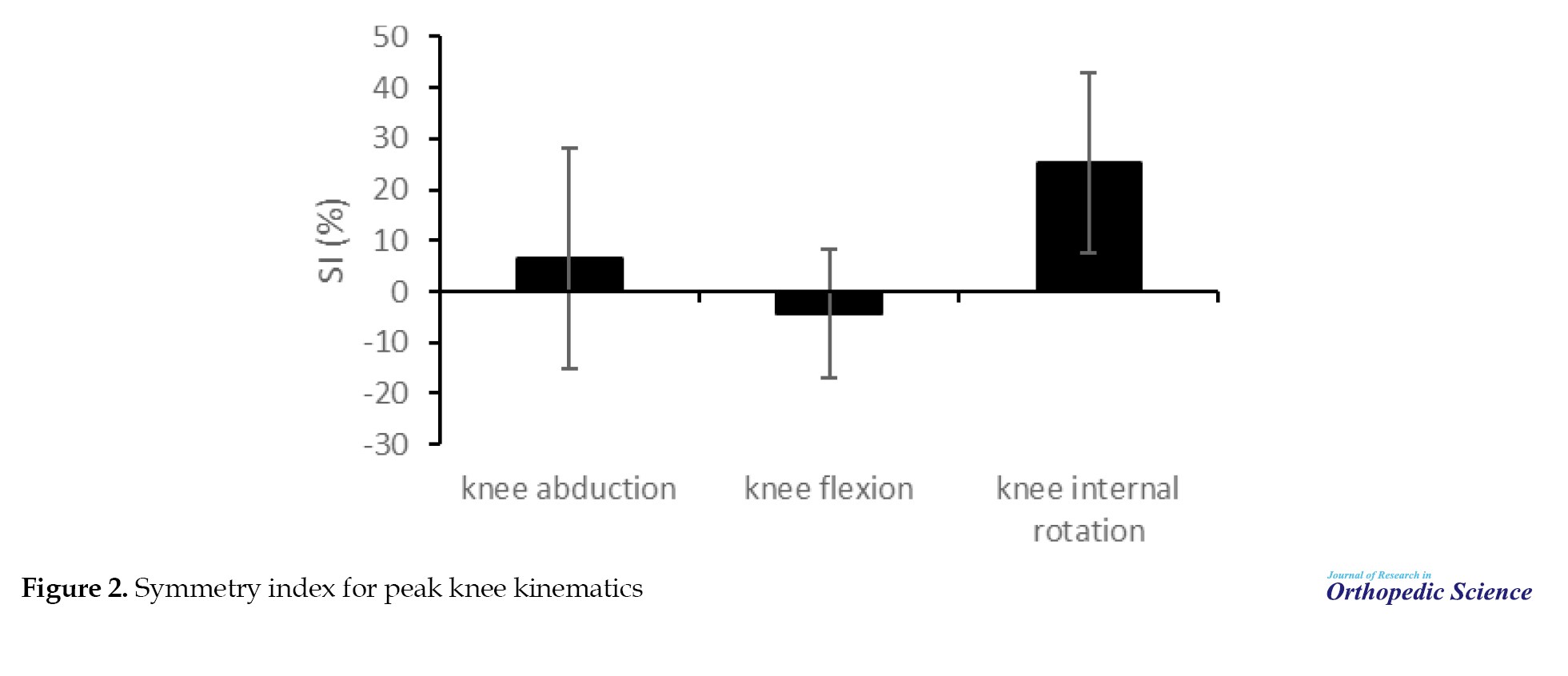
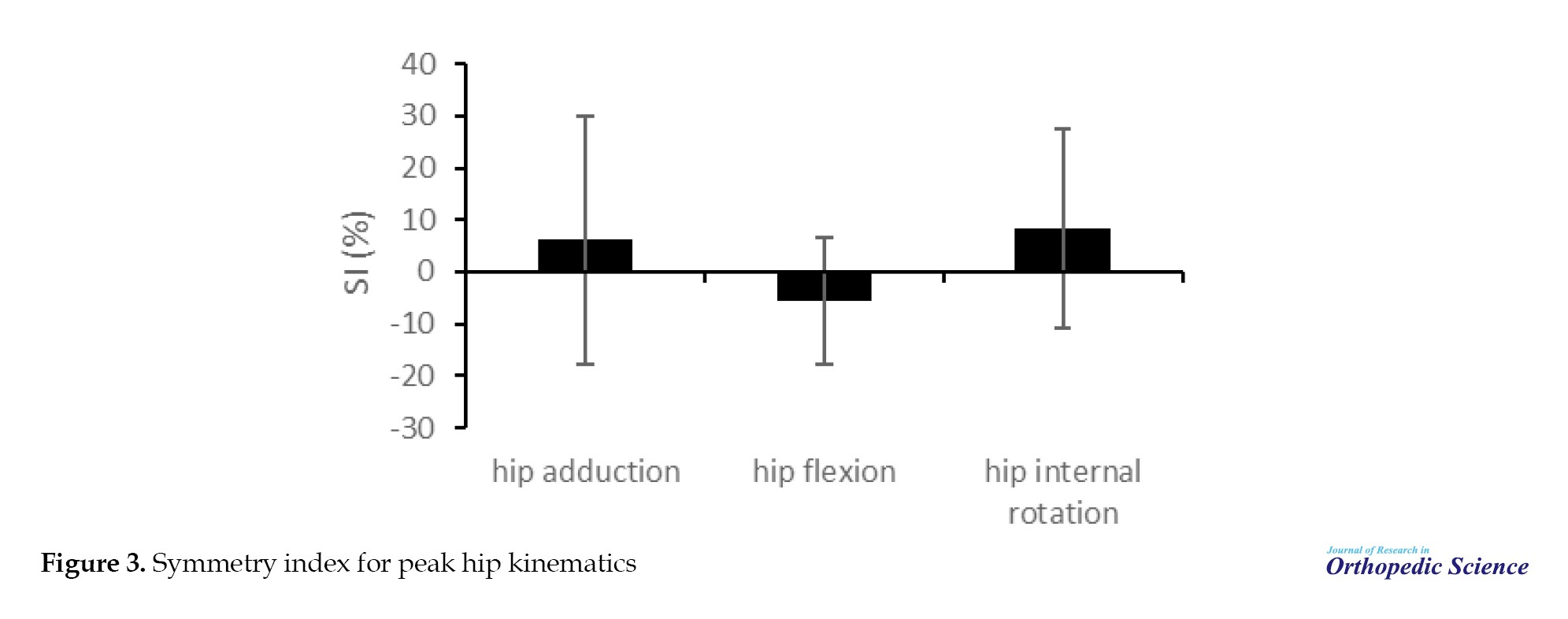
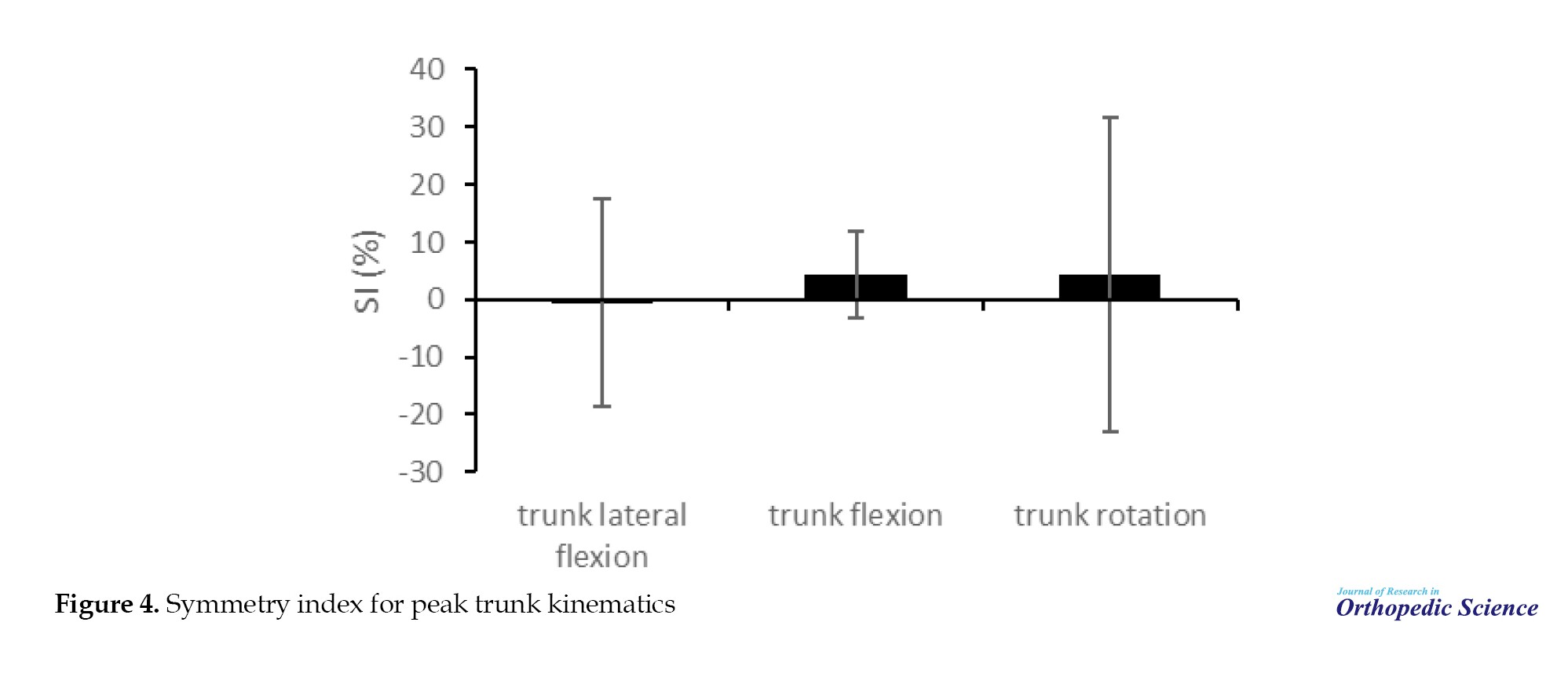
On average, most symmetry indices were close to zero. However, the highest asymmetry values were found for knee rotation angles (25.25%, Figures 2, 3, and 4). Other symmetry values ranged from -0.61% to 8.41%.
Discussion
The purpose of the study was to assess kinematic asymmetry of the lower extremities and trunk during single-leg drop landing in preadolescent female soccer players. We found that knee kinematic data were similar between the dominant and non-dominant legs; the only significant difference was in the peak knee rotation angle. The participants showed greater external rotation angles during landing on the dominant leg than on the contralateral leg. Chun et al. also described a significantly more internally rotated knee in the non-dominant limb compared with the dominant one during drop vertical jump, which was accompanied by hip external rotation and valgus knee alignment [16]. Insufficient knee flexion during landing can also increase ligament strain, indicating the importance of neuromuscular control in avoiding risky movement pattern associated with ACL injuries [17]. However, in our study, the larger knee abduction angles in the dominant leg compared to non-dominant leg were not significant.
In the present study, the examination of the hip kinematic variables revealed a large hip adduction angle in the dominant limb and a small peak hip abduction angle in the non-dominant limb during landing. It has been noted that when the knee is in maximum flexion, a hip adduction angle greater than 5° could increase the risk of an ACL injury [18]. Imwalle et al. reported that increases in hip adduction were accompanied by increases in knee abduction, which were significant predictors of knee valgus alignment [19]. However, excessive hip internal rotation angle has been associated with dynamic knee valgus and an increased risk of ACL injury [20]. Wild et al. found significantly lower hamstring-to-quadriceps ratios, reduced hip abduction moments, greater knee abduction alignment, and similar muscle activation patterns during the landing phase of a horizontal landing movement in the lower hamstring strength group. The authors concluded that the latter appear to have a decreased capacity to control lower limb frontal plane alignment, potentially increasing the risk of ACL injury [21]. Another study found that the FIFA 11+ Kids program, which includes exercises targeting the gluteal muscles, may have been effective in reducing hip internal rotation angle. This means that the specific exercises included in the program may help improve hip stability and control, thereby reducing the risk of dynamic knee valgus and ACL injury [22].
The current study showed that there were higher peak ipsilateral trunk flexion angles when individuals landed on the dominant side than on the non-dominant side. An increased lateral trunk obliquity has been tentatively explained by poor neuromuscular control of the trunk and suggested as a possible predictor mechanism of ACL injury in preadolescent female athletes [23]. According to a video analysis study, ACL injuries in female basketball players were more likely to occur with larger trunk ipsilateral flexion angles [2]. The current results indicate a slightly larger peak trunk flexion angle during dominant leg landing compared with non-dominant leg landing. Some studies have reported that greater trunk flexion reduces the risk of ACL injury compared with landing in an upright position, due to increased hip and knee angles and decreased activity of the quadriceps femoris [24].
Our results showed significant differences in landing kinematics for certain joints when the movement is performed with the dominant or non-dominant sides. These asymmetries may result in excessive loading of one side and contribute to the occurrence of injuries, such as patellofemoral pain and ACL ruptures. To mitigate these risks, prevention protocols should be applied to athletes who display these asymmetries. For example, neuromuscular training can significantly improve hip and core muscle strength and the inter-limbs asymmetry in female players [25]. Some limitations of the present study are that we only examined preadolescent female soccer players while performing single-leg landing at a single moment in time. To better understand the asymmetries between dominant and non-dominant legs, future studies should consider evaluating other populations, different tasks, and before and after a prevention protocol.
Conclusion
The present study found that preadolescent female soccer players exhibited significantly larger hip adduction, knee external rotation, trunk lateral flexion toward the ipsilateral side, and trunk flexion when landing on dominant limb compared to non-dominant limb. Some of these angles have been associated with an increased risk of knee injury. Since preadolescent female athletes are still developing their neuromuscular control and may be more prone to using improper landing techniques, coaches should emphasize the importance of symmetry in movement patterns and equal weight distribution.
Clinical recommendations
Clinicians should prioritize screening the dominant limb because young female athletes often exhibit riskier landing patterns on their preferred side, requiring therapy programs that emphasize movement symmetry and balanced weight distribution to protect the knee joints. These interventions must specifically focus on strengthening the core and hip abductors to prevent compensatory trunk movements, which are critical markers of injury. By identifying and correcting these suboptimal mechanics during preadolescence, practitioners can effectively bridge the neuromuscular gap before growth spurts further escalate the risk of serious ligament injuries.
Ethical Considerations
Compliance with ethical guidelines
The study protocol was approved and registered by the local Ethics Committee (Code: IR.BASU.REC.1400.035) following the standards and guidelines of the Declaration of Helsinki.
Funding
This research did not receive any grant from funding agencies in the public, commercial, or non-profit sectors.
Authors' contributions
All authors equally contributed to preparing this article.
Conflict of interest
The authors declared no conflict of interest.
Acknowledgments
The authors would like to appreciate all players, parents, and coaches cooperating with us in this study.
References
Anterior cruciate ligament (ACL) tears are known as one of the most devastating injuries in sports, such as soccer, basketball, and volleyball; they result from both contact and non-contact situations and affect athletes’ skill and life quality [1]. Most of these injuries occur with improper neuromuscular control during jumping and landing tasks [2]. Read et al. found that single-leg countermovement jump peak landing force asymmetry is the main risk factor for lower extremity injury [3]. Regarding kinetic and kinematic variables during jump landing tasks, limb asymmetry has been applied as a screening method and as a focus in rehabilitation after injury [4]. The asymmetry phenomenon may contribute to a non-contact ACL injury among female athletes [5]. Siebers et al. compared three symmetry indices for hip, knee, and ankle flexion angles during walking, ascending, and descending stairs, and reported that there was acceptable agreement between the three indices [6]. The proposed methods are beneficial for further symmetry analysis, as they take into account within-subject differences between sides and are not affected by the mitigating effects of averaging. One of these methods for symmetry analysis, validated by Gouwanda and Senanayake, is the normalized symmetry index (SI norm) [7]. Some studies have examined asymmetry of the lower limbs in bilateral landing tasks, including forward jump, stop-jump, and double-leg landings [5, 8]. Niu et al. reported that the dominant leg in healthy adults may be at greater risk of injury than the contralateral leg because of asymmetry in muscle activation and ground reaction force during double-leg landing [9]. In another study, the dominant lower extremity exhibited significantly lower knee flexion and hip flexion at initial contact and greater knee external rotation and hip external rotation at peak vertical ground reaction force compared to non-dominant leg, which has been associated with injury [8]. However, during single-leg landings, female soccer players demonstrated smaller range of motion for the knee and hip joints and larger medial and lateral center of pressure displacements in the non-dominant leg compared to the dominant leg, indicating that the non-dominant limb could be more susceptible to injury [10].
The current literature has not reached a consensus regarding which side presents higher kinematic risk for ACL injuries. Rossler et al. confirmed this view by following football players aged 7 to 12 over two seasons in the Czech Republic and Switzerland. The characteristics of injuries in child soccer players are different from those in soccer players of other age groups. For example, 60-90% of sports injuries in children are in the lower extremities [11]. Given that preadolescent girls are still developing their optimal movement pattern and that inter-limb symmetry is important in sport injury prevention, assessing kinematical differences between limbs (directly and using a symmetry index) may provide valuable insights into injuries in this population. Therefore, the purpose of this study was to investigate asymmetry of lower extremities and trunk kinematics during single-leg landing in preadolescent female soccer players.
Methods
Participants
Thirty-six preadolescent female soccer players (mean age: 11.2±1.1 years, height: 148.4±5.4 cm, weight: 40.9±3.5 kg) voluntarily participated in the study. Inclusion criteria were healthy participants aged 10 to 12 years, who played football two times per week for at least six months. Exclusion criteria included history of lower extremity and trunk injuries, ACL injuries or surgery within the past 6 months, and impaired balance. All testing procedures were explained to the participants, and the consent of a parent or guardian was obtained.
Procedure
Kinematic data were collected at 200 Hz with an 8-camera motion capture system (Qualisys; Goteborg, Sweden) positioned around a calibrated test area. A total of 45 markers were placed on the spinous process of C7 and T10, shoulders, scapula inferior angles, sacrum, anterior and posterior superior iliac spines, iliac crests, greater trochanters, lateral and medial knee epicondyles, lateral and medial malleoli, the first and fifth metatarsal heads, and heels. Four clusters composed of 4 markers each were placed on the thigh and shank (Figure 1) [12]. After warming up on a stationary bicycle for 5 minutes, participants were familiarized with the testing procedure by practicing the task three times prior to recording. Participants were instructed to stand on their non-dominant leg with arms crossed in front of their chest and then drop from a 30-cm high box, landing on the ground with the dominant leg [12]. The same protocol was adopted for the non-dominant landing trials. Three successful trials of the single-leg drop landing were collected for each limb with a 30-s rest between trials. A successful trial was considered when participants maintained their balance for at least 3 seconds after landing. The dominant leg was defined as the leg predominantly used to kick a ball [13].
Analysis of recordings
The analyzed landing phase was defined as the interval between the initial contact and peak knee flexion. Initial contact was defined as the moment when markers on the metatarsal heads reached their lowest position. The peak trunk, hip, and knee angles in the sagittal, frontal, and transversal planes during the landing phase were extracted. The position of three-dimensional markers was digitized using Qualisys Track Manager (version 2.2, Qualisys AB, Gothenburg, Sweden), and subsequently analyzed using Visual 3D (C Motion, USA). Data were filtered with a fourth-order zero-lag Butterworth 12 Hz low-pass filter before calculating the dependent variables. Joint angles were calculated using an X-Y-Z Cardan rotation sequence corresponding to the anteroposterior, mediolateral, and vertical axes, respectively [14]. The positive angles indicate knee flexion, knee adduction, knee internal rotation, hip flexion, hip adduction, hip internal rotation, trunk flexion, lateral trunk flexion, and trunk rotation toward the contralateral leg.
Statistical analysis
The Mean±SD were estimated for kinematical variables. The Shapiro-Wilk test indicated a normal distribution of the data. Therefore, paired t-tests were used to compare lower limbs and trunk kinematic variables during landing between dominant and non-dominant limbs, using SPSS software, version 25 (SPSS, Inc., Chicago, IL, USA). The statistical significance was set at P≤0.05. In addition, In addition, the effect size was estimated with Cohen’s d and interpreted as follows: d≥0.20 small, d≥0.50 medium, and d≥0.80 large [15]. For each subject, the normalized symmetry index (SI norm) was also used to analyze the symmetry of the trunk and lower extremities between the dominant and non-dominant legs by calculating Xnorm for both dominant and non-dominant limbs (Equation 1) [7]. D refers to the dominant limb, while N denotes the non-dominant limb.
We found that the dominant leg exhibited significantly greater adduction compared to the non-dominant leg, with a large effect size (p=0.00, d=0.94). During landing with the dominant limb, knee external rotation was observed, while during non-dominant limb landing, knee internal rotation was found (p=0.01, d=-0.44). Additionally, the subjects exhibited larger peak trunk lateral flexion toward the ipsilateral side (p=0.00, d=-0.46) and trunk flexion angles (p=0.00, d=0.46) during landing on the dominant side compared to the non-dominant side, with a small effect size (Table 1).
On average, most symmetry indices were close to zero. However, the highest asymmetry values were found for knee rotation angles (25.25%, Figures 2, 3, and 4). Other symmetry values ranged from -0.61% to 8.41%.
Discussion
The purpose of the study was to assess kinematic asymmetry of the lower extremities and trunk during single-leg drop landing in preadolescent female soccer players. We found that knee kinematic data were similar between the dominant and non-dominant legs; the only significant difference was in the peak knee rotation angle. The participants showed greater external rotation angles during landing on the dominant leg than on the contralateral leg. Chun et al. also described a significantly more internally rotated knee in the non-dominant limb compared with the dominant one during drop vertical jump, which was accompanied by hip external rotation and valgus knee alignment [16]. Insufficient knee flexion during landing can also increase ligament strain, indicating the importance of neuromuscular control in avoiding risky movement pattern associated with ACL injuries [17]. However, in our study, the larger knee abduction angles in the dominant leg compared to non-dominant leg were not significant.
In the present study, the examination of the hip kinematic variables revealed a large hip adduction angle in the dominant limb and a small peak hip abduction angle in the non-dominant limb during landing. It has been noted that when the knee is in maximum flexion, a hip adduction angle greater than 5° could increase the risk of an ACL injury [18]. Imwalle et al. reported that increases in hip adduction were accompanied by increases in knee abduction, which were significant predictors of knee valgus alignment [19]. However, excessive hip internal rotation angle has been associated with dynamic knee valgus and an increased risk of ACL injury [20]. Wild et al. found significantly lower hamstring-to-quadriceps ratios, reduced hip abduction moments, greater knee abduction alignment, and similar muscle activation patterns during the landing phase of a horizontal landing movement in the lower hamstring strength group. The authors concluded that the latter appear to have a decreased capacity to control lower limb frontal plane alignment, potentially increasing the risk of ACL injury [21]. Another study found that the FIFA 11+ Kids program, which includes exercises targeting the gluteal muscles, may have been effective in reducing hip internal rotation angle. This means that the specific exercises included in the program may help improve hip stability and control, thereby reducing the risk of dynamic knee valgus and ACL injury [22].
The current study showed that there were higher peak ipsilateral trunk flexion angles when individuals landed on the dominant side than on the non-dominant side. An increased lateral trunk obliquity has been tentatively explained by poor neuromuscular control of the trunk and suggested as a possible predictor mechanism of ACL injury in preadolescent female athletes [23]. According to a video analysis study, ACL injuries in female basketball players were more likely to occur with larger trunk ipsilateral flexion angles [2]. The current results indicate a slightly larger peak trunk flexion angle during dominant leg landing compared with non-dominant leg landing. Some studies have reported that greater trunk flexion reduces the risk of ACL injury compared with landing in an upright position, due to increased hip and knee angles and decreased activity of the quadriceps femoris [24].
Our results showed significant differences in landing kinematics for certain joints when the movement is performed with the dominant or non-dominant sides. These asymmetries may result in excessive loading of one side and contribute to the occurrence of injuries, such as patellofemoral pain and ACL ruptures. To mitigate these risks, prevention protocols should be applied to athletes who display these asymmetries. For example, neuromuscular training can significantly improve hip and core muscle strength and the inter-limbs asymmetry in female players [25]. Some limitations of the present study are that we only examined preadolescent female soccer players while performing single-leg landing at a single moment in time. To better understand the asymmetries between dominant and non-dominant legs, future studies should consider evaluating other populations, different tasks, and before and after a prevention protocol.
Conclusion
The present study found that preadolescent female soccer players exhibited significantly larger hip adduction, knee external rotation, trunk lateral flexion toward the ipsilateral side, and trunk flexion when landing on dominant limb compared to non-dominant limb. Some of these angles have been associated with an increased risk of knee injury. Since preadolescent female athletes are still developing their neuromuscular control and may be more prone to using improper landing techniques, coaches should emphasize the importance of symmetry in movement patterns and equal weight distribution.
Clinical recommendations
Clinicians should prioritize screening the dominant limb because young female athletes often exhibit riskier landing patterns on their preferred side, requiring therapy programs that emphasize movement symmetry and balanced weight distribution to protect the knee joints. These interventions must specifically focus on strengthening the core and hip abductors to prevent compensatory trunk movements, which are critical markers of injury. By identifying and correcting these suboptimal mechanics during preadolescence, practitioners can effectively bridge the neuromuscular gap before growth spurts further escalate the risk of serious ligament injuries.
Ethical Considerations
Compliance with ethical guidelines
The study protocol was approved and registered by the local Ethics Committee (Code: IR.BASU.REC.1400.035) following the standards and guidelines of the Declaration of Helsinki.
Funding
This research did not receive any grant from funding agencies in the public, commercial, or non-profit sectors.
Authors' contributions
All authors equally contributed to preparing this article.
Conflict of interest
The authors declared no conflict of interest.
Acknowledgments
The authors would like to appreciate all players, parents, and coaches cooperating with us in this study.
References
- Alentorn-Geli E, Myer GD, Silvers HJ, Samitier G, Romero D, Lázaro-Haro C, et al. Prevention of non-contact anterior cruciate ligament injuries in soccer players. Part 1: Mechanisms of injury and underlying risk factors. Knee Surg Sports Traumatol Arthrosc. 2009; 17(7):705-29. [DOI:10.1007/s00167-009-0813-1] [PMID]
- Hewett TE, Torg JS, Boden BP. Video analysis of trunk and knee motion during non-contact anterior cruciate ligament injury in female athletes: Lateral trunk and knee abduction motion are combined components of the injury mechanism. Br J Sports Med. 2009; 43(6):417-22. [DOI:10.1136/bjsm.2009.059162] [PMID]
- Read PJ, Oliver JL, De Ste Croix MBA, Myer GD, Lloyd RS. A prospective investigation to evaluate risk factors for lower extremity injury risk in male youth soccer players. Scand J Med Sci Sports. 2018; 28(3):1244-51. [DOI:10.1111/sms.13013] [PMID]
- Ruedl G, Webhofer M, Helle K, Strobl M, Schranz A, Fink C, et al. Leg dominance is a risk factor for noncontact anterior cruciate ligament injuries in female recreational skiers. Am J Sports Med. 2012; 40(6):1269-73. [DOI:10.1177/0363546512439027] [PMID]
- Pappas E, Carpes FP. Lower extremity kinematic asymmetry in male and female athletes performing jump-landing tasks. J Sci Med Sport. 2012; 15(1):87-92. [DOI:10.1016/j.jsams.2011.07.008] [PMID]
- Siebers HL, Alrawashdeh W, Betsch M, Migliorini F, Hildebrand F, Eschweiler J. Comparison of different symmetry indices for the quantification of dynamic joint angles. BMC Sports Sci Med Rehabil. 2021; 13(1):130. [DOI:10.1186/s13102-021-00355-4] [PMID]
- Gouwanda D, Senanayake SM. Identifying gait asymmetry using gyroscopes--a cross-correlation and normalized symmetry index approach. J Biomech. 2011; 44(5):972-8. [DOI:10.1016/j.jbiomech.2010.12.013] [PMID]
- Edwards S, Steele JR, Cook JL, Purdam CR, McGhee DE. Lower limb movement symmetry cannot be assumed when investigating the stop-jump landing. Med Sci Sports Exerc. 2012; 44(6):1123-30. [DOI:10.1249/MSS.0b013e31824299c3] [PMID]
- Niu W, Wang Y, He Y, Fan Y, Zhao Q. Kinematics, kinetics, and electromyogram of ankle during drop landing: A comparison between dominant and non-dominant limb. Hum Mov Sci. 2011; 30(3):614-23. [DOI:10.1016/j.humov.2010.10.010] [PMID]
- Wang J, Fu W. Asymmetry between the dominant and non-dominant legs in the lower limb biomechanics during single-leg landings in females. Adv Mech Eng. 2019; 11(5). [DOI:10.1177/1687814019849794]
- Rössler R, Junge A, Chomiak J, Dvorak J, Faude O. Soccer Injuries in Players Aged 7 to 12 Years: A descriptive epidemiological study over 2 seasons. Am J Sports Med. 2016; 44(2):309-17. [DOI:10.1177/0363546515614816] [PMID]
- Xu D, Zhou H, Baker JS, István B, Gu Y. An investigation of differences in lower extremity biomechanics during single-leg landing from height using bionic shoes and normal shoes. Front Bioeng Biotechnol. 2021; 9:679123. [DOI:10.3389/fbioe.2021.679123] [PMID]
- Taghizadeh Kerman M, Ebrahimi Atri A, Hashemi Javaheri SAA. The effect of FIFA 11+ injury prevention program on dynamic balance and knee isometric strength of female players in soccer super league. World Fam Med J. 2018; 16(7):48-54. [DOI:10.5742/MEWFM.2018.93475]
- Cole GK, Nigg BM, Ronsky JL, Yeadon MR. Application of the joint coordinate system to three-dimensional joint attitude and movement representation: A standardization proposal. J Biomech Eng. 1993; 115(4A):344-9. [DOI:10.1115/1.2895496] [PMID]
- Cohen J. Statistical Power Analysis for the Behavioral Sciences. New Jersey: Lawrence Erlbaum Associates; 1988. [Link]
- Chun Y, Bailey JP, Kim J, Lee SC, Lee SY. Sex and limb differences in lower extremity alignment and kinematics during drop vertical jumps. Int J Environ Res Public Health. 2021; 18(7):3748. [DOI:10.3390/ijerph18073748] [PMID]
- Nemati N, Norasteh AA, Shamsi Majelan A. The effect of a neuromuscular training program on landing kinematics in young soccer players with poor landing mechanics. J Rehabil Sci Res. 2023; 10(3):145-50. [DOI:10.30476/jrsr.2022.95384.1289]
- Morishige Y, Harato K, Kobayashi S, Niki Y, Matsumoto M, Nakamura M, et al. Difference in leg asymmetry between female collegiate athletes and recreational athletes during drop vertical jump. J Orthop Surg Res. 2019; 14(1):424. [DOI:10.1186/s13018-019-1490-5] [PMID]
- Imwalle LE, Myer GD, Ford KR, Hewett TE. Relationship between hip and knee kinematics in athletic women during cutting maneuvers: A possible link to noncontact anterior cruciate ligament injury and prevention. J Strength Cond Res. 2009; 23(8):2223-30. [DOI:10.1519/JSC.0b013e3181bc1a02] [PMID]
- Willy RW, Davis IS. The effect of a hip-strengthening program on mechanics during running and during a single-leg squat. J Orthop Sports Phys Ther. 2011; 41(9):625-32. [DOI:10.2519/jospt.2011.3470] [PMID]
- Wild CY, Steele JR, Munro BJ. Insufficient hamstring strength compromises landing technique in adolescent girls. Med Sci Sports Exerc. 2013; 45(3):497-505. [DOI:10.1249/MSS.0b013e31827772f6] [PMID]
- Taghizadeh Kerman M, Brunetti C, Yalfani A, Atri AE, Sforza C. The effects of FIFA 11 + kids prevention program on kinematic risk factors for ACL injury in preadolescent female soccer players: a randomized controlled trial. Children (Basel). 2023; 10(7):1206. [DOI:10.3390/children10071206] [PMID]
- Zazulak BT, Hewett TE, Reeves NP, Goldberg B, Cholewicki J. Deficits in neuromuscular control of the trunk predict knee injury risk: A prospective biomechanical-epidemiologic study. Am J Sports Med. 2007; 35(7):1123-30. [DOI:10.1177/0363546507301585] [PMID]
- Saito A, Okada K, Sasaki M, Wakasa M. Influence of the trunk position on knee kinematics during the single-leg landing: implications for injury prevention. Sports Biomech. 2022; 21(7):810-23. [DOI:10.1080/14763141.2019.1691642] [PMID]
- Sabet S, Letafatkar A, Eftekhari F, Khosrokiani Z, Gokeler A. Trunk and hip control neuromuscular training to target inter limb asymmetry deficits associated with anterior cruciate ligament injury. Phys Ther Sport. 2019; 38:71-9.[DOI:10.1016/j.ptsp.2019.04.014] [PMID]
Type of Study: Research Article |
Subject:
Foot and Ankle
Received: 2025/01/12 | Accepted: 2025/04/18 | Published: 2025/05/1
Received: 2025/01/12 | Accepted: 2025/04/18 | Published: 2025/05/1
| Rights and permissions | |
 |
This work is licensed under a Creative Commons Attribution-NonCommercial 4.0 International License. |

Copyright © The Author(s);
This is an open access article distributed under the terms of the Creative Commons Attribution License (CC-By-NC), which permits use, distribution, and reproduction in any medium, provided the original work is properly cited and is not used for commercial purposes.
Contact Information
