

Volume 12, Issue 1 (Winter 2025)
JROS 2025, 12(1): 57-64 |
Back to browse issues page




Download citation:
BibTeX | RIS | EndNote | Medlars | ProCite | Reference Manager | RefWorks
Send citation to:


BibTeX | RIS | EndNote | Medlars | ProCite | Reference Manager | RefWorks
Send citation to:
Chehrassan M, Nikouei F, Shakeri M, Azarnia G, Ahmadi R, Ghavidel E, et al . Complications and Radiological Findings in One-stage Versus Two-stage Revision Surgery for Complex Degenerative Spinal Deformities. JROS 2025; 12 (1) :57-64
URL: http://jros.iums.ac.ir/article-1-2291-en.html
URL: http://jros.iums.ac.ir/article-1-2291-en.html
Mohammadreza Chehrassan1 

 , Farshad Nikouei1 , Mohammadreza Shakeri1 , Gholamreza Azarnia2 , Reza Ahmadi2 , Ehsan Ghavidel1 , Ebrahim Ameri Mahabadi1 , Hasan Ghandhari1
, Farshad Nikouei1 , Mohammadreza Shakeri1 , Gholamreza Azarnia2 , Reza Ahmadi2 , Ehsan Ghavidel1 , Ebrahim Ameri Mahabadi1 , Hasan Ghandhari1
1- Department of Orthopedics, Bone and Joint Reconstruction Research Center, School of Medicine, Iran University of Medical Sciences, Tehran, Iran.
2- Department of Orthopedics, Bone and Joint Reconstruction Research Center, School of Medicine, Iran University of Medical Sciences, Tehran, Iran. & Department of Orthopedics Surgery, Shafayahyaeian Hospital, Iran University of Medical Sciences, Tehran, Iran.
2- Department of Orthopedics, Bone and Joint Reconstruction Research Center, School of Medicine, Iran University of Medical Sciences, Tehran, Iran. & Department of Orthopedics Surgery, Shafayahyaeian Hospital, Iran University of Medical Sciences, Tehran, Iran.
Keywords: Revision surgery, Long-segment, Posterior spinal fusion (PSF), Spinal deformity, One stage, Two stage, Complications, Outcomes
Full-Text [PDF 525 kb]
(167 Downloads)
| Abstract (HTML) (663 Views)
References
Full-Text: (120 Views)
Introduction
Complex degenerative spinal deformity is a condition increasingly observed in aging populations. It encompasses a spectrum of disorders characterized by progressive degeneration of the intervertebral discs, facet joints, and paraspinal musculature [1, 2]. These degenerative conditions may result in global spinal malalignment, lumbar spinal stenosis, and a range of disabling symptoms such as chronic back pain, radiculopathy, and gait disturbance [3]. With its growing prevalence, the demand for surgical treatment has increased, especially among individuals aged 65 and older [4].
Surgical intervention, most commonly posterior spinal fusion (PSF), is often warranted when conservative measures fail, with the primary objectives being the restoration of spinal alignment, alleviation of pain, and promotion of spinal stability through successful fusion [5, 6]. However, revision surgery in this context is frequently required due to non:union:, implant failure, adjacent segment disease, or residual deformity following primary fusion procedures [7, 8].
Revision surgery is technically demanding, associated with prolonged operative times, increased blood loss, and heightened risk of perioperative complications [9]. Two major strategies could be employed: One-stage and two-stage revision [10]. One-stage revision surgery offers the advantage of completing correction and fusion in a single setting, thereby reducing hospitalization and overall treatment duration. However, it carries the disadvantage of greater intraoperative physiological stress and a higher risk of complications [10]. On the other hand, two-stage revision surgery allows for gradual correction, potentially reducing operative time per procedure and perioperative morbidity, but at the cost of prolonged hospitalization, delayed rehabilitation, and cumulative risks of multiple anesthetics [10]. Although several studies have compared one-stage and two-stage strategies across various clinical scenarios [10-12], there is no clear consensus on the superiority of either approach, particularly in revision surgeries.
In this study, we compare radiologic outcomes and complications between one-stage and two-stage procedures in a cohort of patients with degenerative spinal deformity undergoing revision long-segment PSF.
Methods
Study design
The Review Board of Iran University of Medical Sciences approved this retrospective cohort study. Medical records of patients who underwent revision long-segment PSF between 2021 and 2023 at our tertiary hospital were retrospectively reviewed, and eligible patients were included in the study. Patients were included if diagnosed with degenerative spinal deformity, aged >18 years, had single- or two-stage posterior interbody fusion combined with lumbar decompression and instrumentation spanning T9/T12 to S2-iliac. The exclusion criteria were a follow-up period of less than 12 months and incomplete medical documentation. Forty-five patients who met the study criteria were included in the final analysis.
Surgical procedure
The same team of experienced orthopedic spine surgeons did all procedures. Anesthetic and perioperative protocols were the same across both groups. Surgical techniques and instrumentation were also consistent across the two groups, with posterior pedicle screw fixation as the primary method of stabilization. Intraoperative neuromonitoring was routinely employed to enhance safety and continuously assess neurological function throughout the surgeries. In the one-stage group, all procedures, including complete long-segment PSF with instrumentation, decompression, and interbody fusion, were performed during a single operative session. In the two-stage group, the first stage consisted of a long-segment PSF with instrumentation, followed by decompression and interbody fusion in a second operation, typically performed within 3 to 7 days of the initial procedure. The decision between single- and two-stage procedures was based on the surgeon’s preference, operating room availability, and evolving institutional protocols.
Postoperative protocols
The same postoperative care, including pain management strategy and rehabilitation plans, was implemented for both single and two-staged groups. In scheduled two-stage cases, patients were mobilized between the first and second stages. This procedure included ambulation over short distances while wearing a thoracolumbosacral orthosis.
Data collection
Demographic data, including age, sex, body mass index (BMI), and follow-up duration, and operative data, including operation time, estimated blood loss, amount of blood transfusion, pre- and post-operative hemoglobin levels, and length of hospitalization, were extracted from the patients’ medical records. Peri- and postoperative complications were also extracted from the patient’s medical history. Radiological parameters were retrieved from our hospital’s Picture Archiving and Communication System. They included pelvic tilt, pelvic incidence, sacral slope, lumbar lordosis, proximal junctional angle, sagittal vertical axis (SVA), and coronal vertical axis (CVA). Two spine surgeons independently performed all radiographic assessments. In cases of discrepancy, the images were jointly reviewed, and a consensus decision was reached.
Statistical analysis
Statistical analyses were performed using SPSS software, version 19.0 (IBM Corp., Armonk, NY, USA). Quantitative variables were demonstrated with Mean±SD. Qualitative variables were presented as frequencies and percentages. Normality of distribution was evaluated using the Shapiro-Wilk test. For within-group comparisons, a paired t-test was used for normally distributed variables, while the Wilcoxon signed-rank test was used for non-normally distributed variables. For between-group comparisons, an independent t-test was used for normally distributed variables, while the Mann-Whitney U test was used for non-normally distributed variables. Categorical variables were compared using the chi-square test or the Fisher exact test. A P<0.05 was considered statistically significant.
Results
Demographic data
The study population included 45 patients: 29 underwent a single-stage procedure and 16 underwent a two-stage procedure. The baseline demographic and imaging characteristics of the two study groups are presented in Table 1.
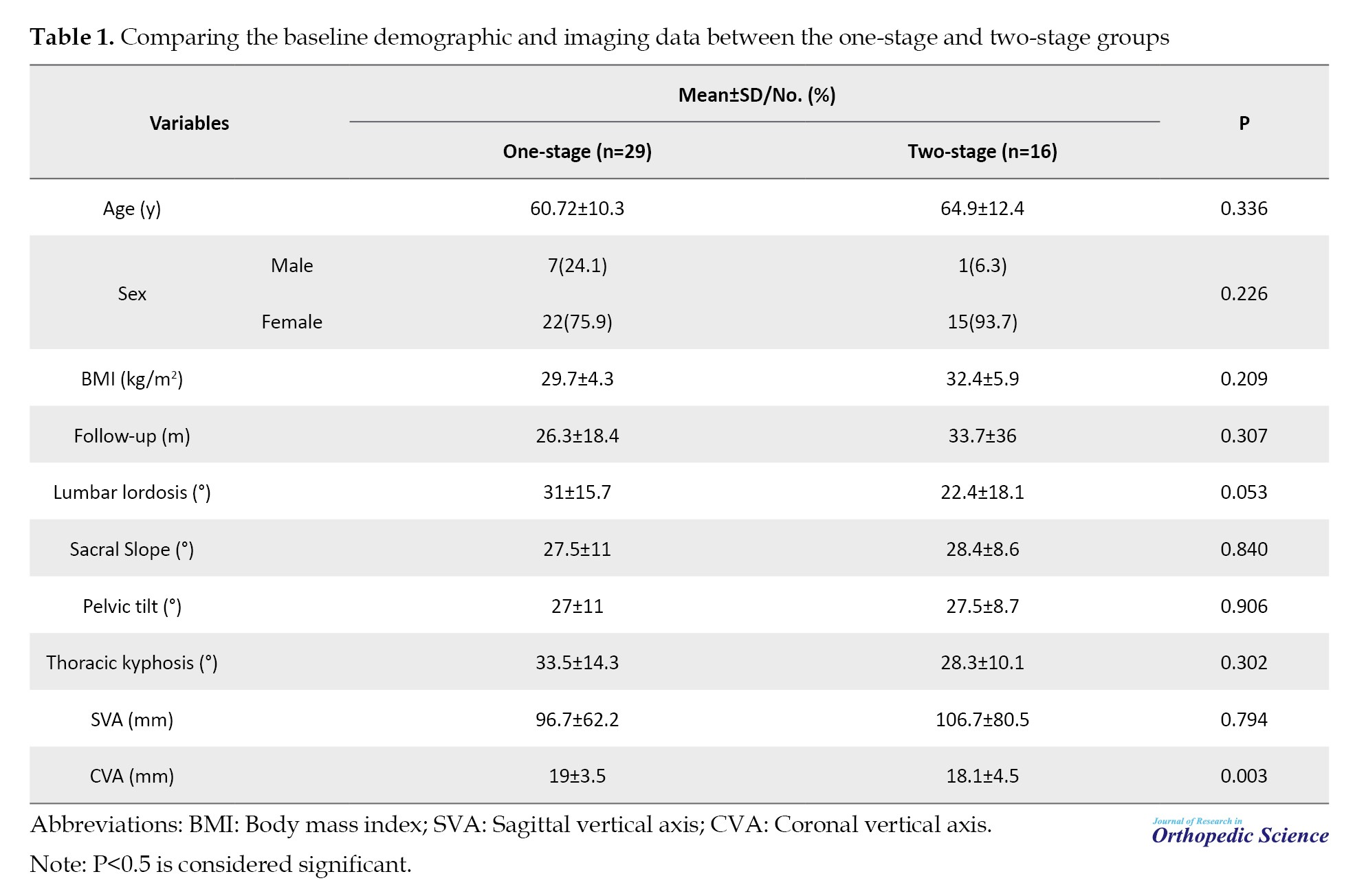
Preoperative CVA was the only baseline parameter that significantly differed between the two groups (P=0.003).
Within-group analysis
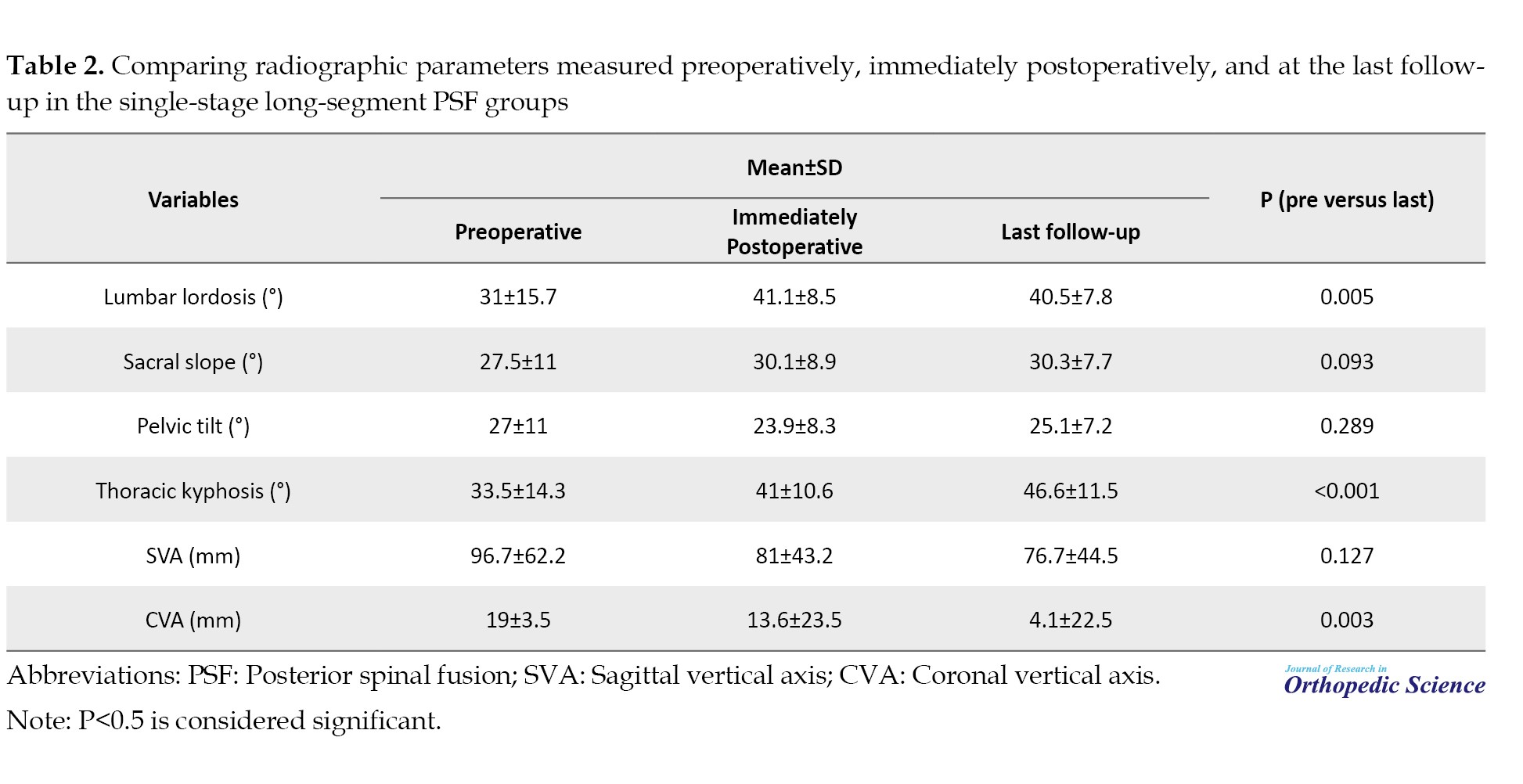
In the single-stage group, the mean lumbar lordosis significantly improved immediately after the operation and remained almost unchanged until the last follow-up. The same was observed for sacral slope. Thoracic kyphosis, SVA, and CVA showed continuous improvement after the operation. Pelvic tilt improved from 27° to 23.9°, with a small recurrence to 25° observed at the final follow-up (Table 2).
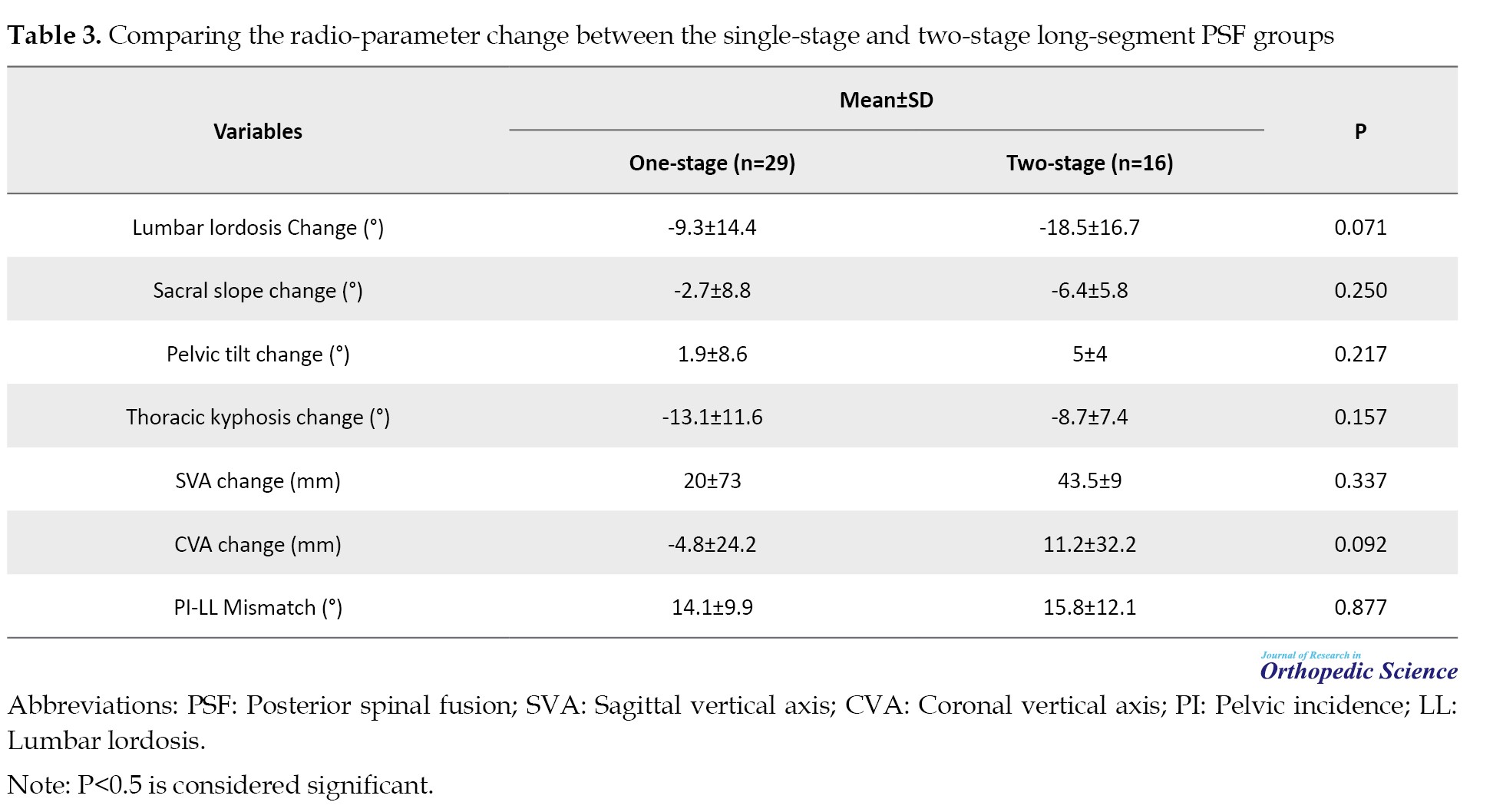
In the two-stage group, the overall pattern of change was comparable across all parameters, with only minor differences in the magnitude of improvement (Table 3).
Between-group analysis
Table 4 compares radiographic parameter changes between single-stage and two-stage long-segment PSF.
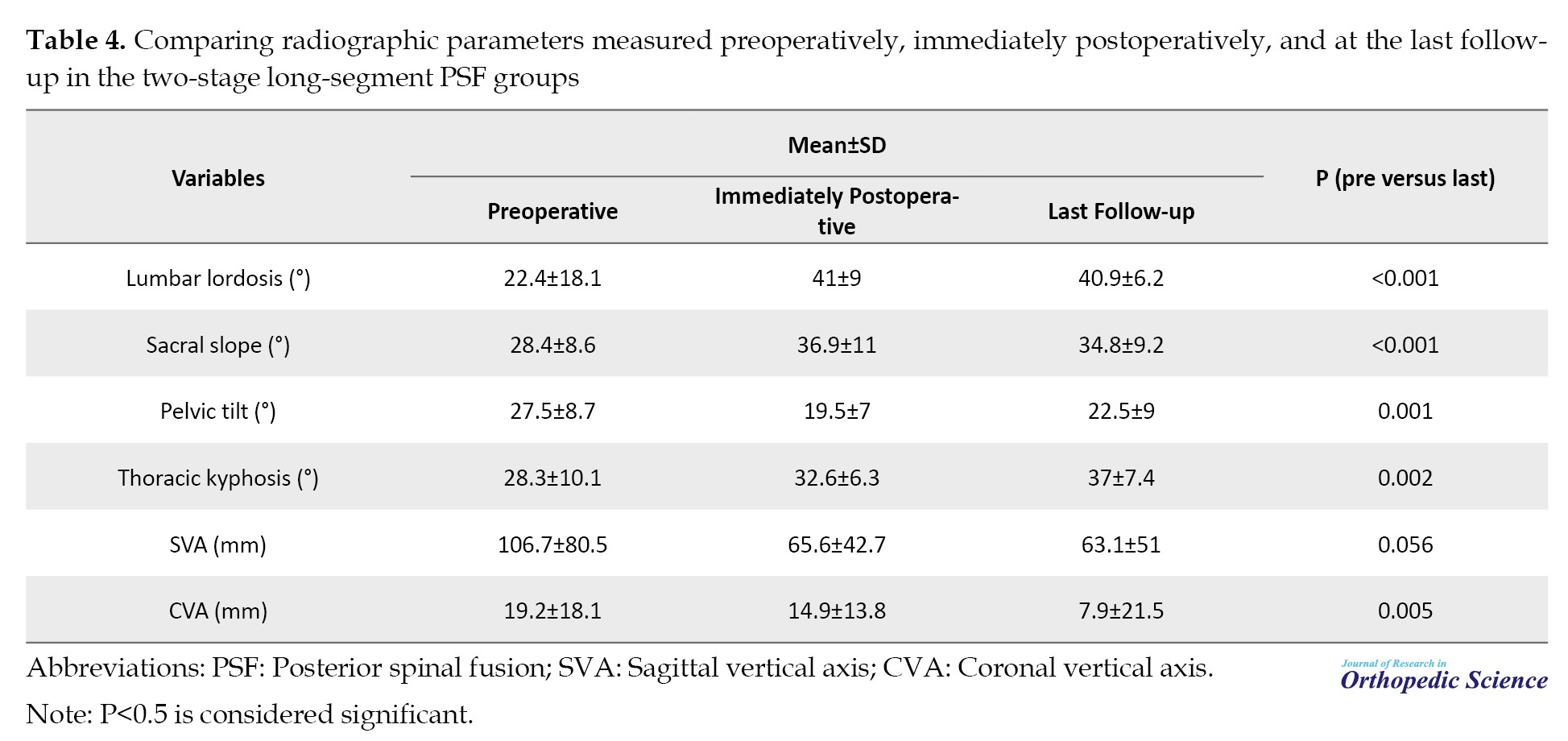
Both groups showed improvements in sagittal and coronal alignment, with no statistically significant differences between them. Although the two-stage group tended to show larger changes in lumbar lordosis and pelvic tilt, these changes did not reach significance.
Perioperative parameter comparison
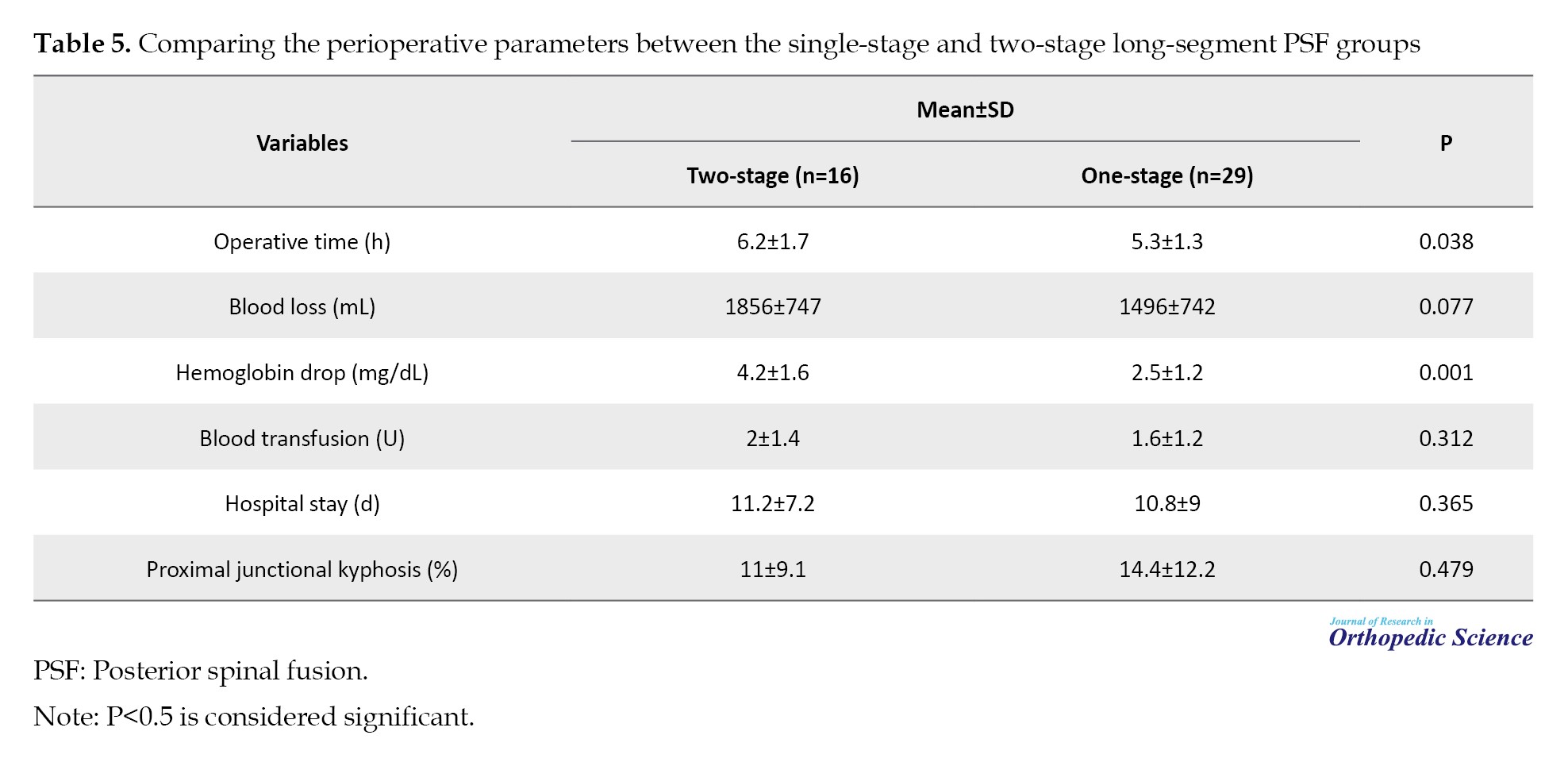
The two-stage group had significantly longer operative times. Hemoglobin drop, transfusion requirements, blood loss, and hospital stay were higher in the two-stage group, but the differences were not statistically significant. The percentage of proximal junctional kyphosis was slightly lower in the two-stage group, though this difference was not statistically significant (Table 5).
Complications
Table 6 summarizes postoperative complications in the single-stage and two-stage groups.
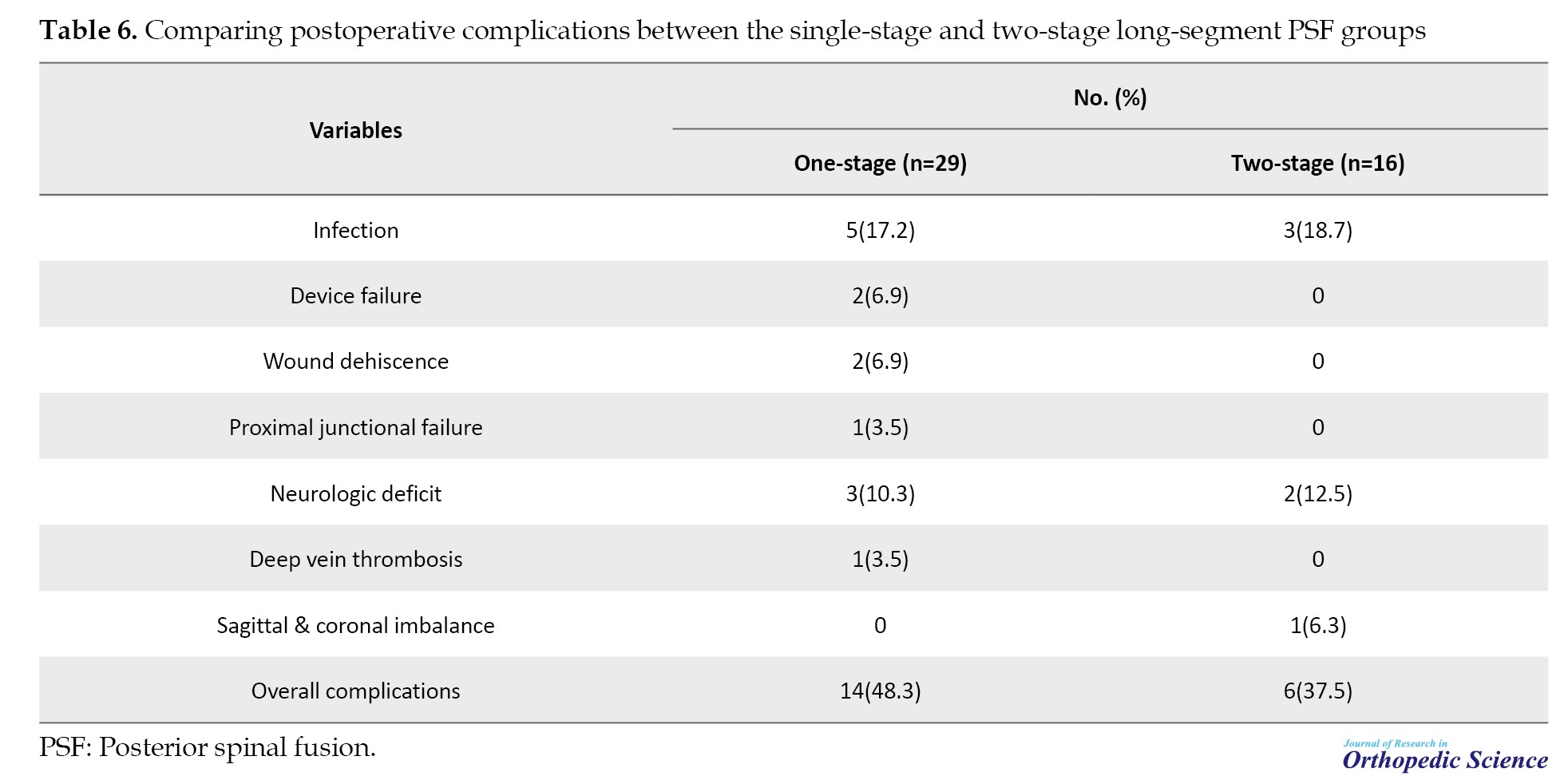
The most common complication in both groups was infection, followed by neurologic deficit. Overall complication rates were slightly higher in the single-stage group (48.3%) compared to the two-stage group (37.5%). However, this difference was not statistically significant (P=0.544).
Discussion
This study compared radiological outcomes, perioperative data, and complication profiles between one-stage and two-stage revision long-segment PSF in patients with complex degenerative spinal deformities. Both surgical strategies were effective in improving sagittal and coronal alignment, with no statistically significant differences in the degree of correction achieved. The surgical time and the hemoglobin drop were significantly longer in the two-stage group. Complication rates were slightly, but not significantly, higher in the single-stage group (48.3% vs 37.5%).
The choice between one-stage and two-stage PSF has long been a subject of debate. Maddox et al. compared staged versus unstaged posterior-only thoracolumbar fusions in adults with spinal deformity. Despite the staged cohort being older, they found no significant difference in perioperative complication rates between the two strategies. A subset of patients planned for unstaged surgery required intraoperative conversion to a staged approach, which was primarily associated with higher ASA scores rather than increased complications. These findings suggest that both staged and unstaged procedures can be safe options, with patient comorbidities influencing the choice of strategy [13]. Viviani et al. [10] compared the postoperative morbidity and hospital stay between one-staged and two-staged combined anterior and PSF. The one-stage procedure was associated with a significantly shorter hospital stay and fewer complications. Dick et al. [14] compared outcomes of one-stage versus two-stage anterior and PSF in adults, evaluating complication rates, hospital costs, and other perioperative factors. They found that patients in the staged group had longer hospital stays, higher costs, and a greater incidence of wound infections. Importantly, all patients preferred the one-stage procedure, which was associated with lower morbidity and lower overall costs. Viezens et al. [15]conducted a retrospective matched-pair cohort study of 247 patients undergoing posterior–anterior spinal fusion via thoracoscopic approach, comparing single-stage and two-stage procedures. Both procedures demonstrated comparable perioperative safety profiles and complication rates. The single-stage procedure, however, was associated with a shorter hospital stay, albeit with slightly higher pain levels in the immediate postoperative period, which resolved within 30 days. Consistently, we observed a longer hospital stay in patients who underwent two-stage surgery. Moreover, the operation time and hemoglobin drop were significantly greater in the two-staged group. These observations, in line with the earlier studies, confirm that a one-staged procedure provides better perioperative outcomes.
Verma et al. [16] conducted a systematic review and meta-analysis of 11 studies involving 1323 patients undergoing staged or same-day spinal fusion for adult spinal deformity. Staged surgery was associated with longer operative time, prolonged hospitalization, and a higher risk of venous thromboembolism. In contrast, no significant differences were observed regarding blood loss, radiologic outcomes, or overall complication rates. The most frequent complication in the stage group was surgical site infection, whereas neurological complications predominated in the same-day group. Overall, the authors concluded that while both approaches achieve comparable clinical and radiologic efficacy, staged surgery is associated with inferior perioperative outcomes. Similarly, in the present study, the two-stage procedure showed no clear benefit in radiologic outcomes or complication rates compared to the one-stage procedure. Infection was the most common complication in both study groups. Neurological complications were not significantly different between the one-stage and two-stage groups, possibly because intraoperative neuromonitoring was used in all surgeries [17]. Moreover, no deep vein thrombosis was observed in the two-stage group, which may be attributed to immediate ambulation after the first operation [18-20].
In the present study, we included only patients undergoing revision surgery, which is naturally associated with higher risks of morbidity, including surgical site infections, urinary tract infections, and prolonged hospitalization [8]. Nevertheless, our findings demonstrate that a single-stage procedure does not confer a higher risk of complications compared with a two-stage approach, even in the context of revision long-segment PSF.
This study has several limitations that should be acknowledged. First, its retrospective design is by nature associated with selection bias and limits the ability to establish causal relationships. Second, the relatively small sample size, particularly in the two-stage group, could have reduced the statistical power to detect subtle differences between the groups. Third, the follow-up duration was limited to 12 months, which may not be sufficient to capture long-term complications. Fourth and finally, this study focused primarily on radiological and perioperative parameters; important clinical outcomes, such as patient-reported pain, quality of life, and functional recovery, were not assessed due to the retrospective study design.
Conclusion
In patients undergoing revision long-segment PSF for complex degenerative spinal deformities, both one-stage and two-stage procedures provided comparable radiologic outcomes and overall complication rates. However, the one-stage approach is associated with shorter operative time, reduced hemoglobin drop, and shorter hospital stay, without increased complications. These findings suggest that single-stage revision surgery may offer favorable perioperative outcomes compared with staged procedures, even in the technically demanding context of revision surgery. Larger, prospective, multicenter studies with longer follow-up and incorporation of patient-reported outcomes are warranted to validate these results.
Ethical Considerations
Compliance with ethical guidelines
This study was approved by the Research Ethics Committee of Iran University of Medical Sciences, Tehran, Iran.
Funding
This research did not receive any grant from funding agencies in the public, commercial, or non-profit sectors.
Authors' contributions
All authors contributed equally to the conception and design of the study, data collection and analysis, interception of the results and drafting of the manuscript. Each author approved the final version of the manuscript for submission.
Conflict of interest
The authors declared no conflict of interest.
Complex degenerative spinal deformity is a condition increasingly observed in aging populations. It encompasses a spectrum of disorders characterized by progressive degeneration of the intervertebral discs, facet joints, and paraspinal musculature [1, 2]. These degenerative conditions may result in global spinal malalignment, lumbar spinal stenosis, and a range of disabling symptoms such as chronic back pain, radiculopathy, and gait disturbance [3]. With its growing prevalence, the demand for surgical treatment has increased, especially among individuals aged 65 and older [4].
Surgical intervention, most commonly posterior spinal fusion (PSF), is often warranted when conservative measures fail, with the primary objectives being the restoration of spinal alignment, alleviation of pain, and promotion of spinal stability through successful fusion [5, 6]. However, revision surgery in this context is frequently required due to non:union:, implant failure, adjacent segment disease, or residual deformity following primary fusion procedures [7, 8].
Revision surgery is technically demanding, associated with prolonged operative times, increased blood loss, and heightened risk of perioperative complications [9]. Two major strategies could be employed: One-stage and two-stage revision [10]. One-stage revision surgery offers the advantage of completing correction and fusion in a single setting, thereby reducing hospitalization and overall treatment duration. However, it carries the disadvantage of greater intraoperative physiological stress and a higher risk of complications [10]. On the other hand, two-stage revision surgery allows for gradual correction, potentially reducing operative time per procedure and perioperative morbidity, but at the cost of prolonged hospitalization, delayed rehabilitation, and cumulative risks of multiple anesthetics [10]. Although several studies have compared one-stage and two-stage strategies across various clinical scenarios [10-12], there is no clear consensus on the superiority of either approach, particularly in revision surgeries.
In this study, we compare radiologic outcomes and complications between one-stage and two-stage procedures in a cohort of patients with degenerative spinal deformity undergoing revision long-segment PSF.
Methods
Study design
The Review Board of Iran University of Medical Sciences approved this retrospective cohort study. Medical records of patients who underwent revision long-segment PSF between 2021 and 2023 at our tertiary hospital were retrospectively reviewed, and eligible patients were included in the study. Patients were included if diagnosed with degenerative spinal deformity, aged >18 years, had single- or two-stage posterior interbody fusion combined with lumbar decompression and instrumentation spanning T9/T12 to S2-iliac. The exclusion criteria were a follow-up period of less than 12 months and incomplete medical documentation. Forty-five patients who met the study criteria were included in the final analysis.
Surgical procedure
The same team of experienced orthopedic spine surgeons did all procedures. Anesthetic and perioperative protocols were the same across both groups. Surgical techniques and instrumentation were also consistent across the two groups, with posterior pedicle screw fixation as the primary method of stabilization. Intraoperative neuromonitoring was routinely employed to enhance safety and continuously assess neurological function throughout the surgeries. In the one-stage group, all procedures, including complete long-segment PSF with instrumentation, decompression, and interbody fusion, were performed during a single operative session. In the two-stage group, the first stage consisted of a long-segment PSF with instrumentation, followed by decompression and interbody fusion in a second operation, typically performed within 3 to 7 days of the initial procedure. The decision between single- and two-stage procedures was based on the surgeon’s preference, operating room availability, and evolving institutional protocols.
Postoperative protocols
The same postoperative care, including pain management strategy and rehabilitation plans, was implemented for both single and two-staged groups. In scheduled two-stage cases, patients were mobilized between the first and second stages. This procedure included ambulation over short distances while wearing a thoracolumbosacral orthosis.
Data collection
Demographic data, including age, sex, body mass index (BMI), and follow-up duration, and operative data, including operation time, estimated blood loss, amount of blood transfusion, pre- and post-operative hemoglobin levels, and length of hospitalization, were extracted from the patients’ medical records. Peri- and postoperative complications were also extracted from the patient’s medical history. Radiological parameters were retrieved from our hospital’s Picture Archiving and Communication System. They included pelvic tilt, pelvic incidence, sacral slope, lumbar lordosis, proximal junctional angle, sagittal vertical axis (SVA), and coronal vertical axis (CVA). Two spine surgeons independently performed all radiographic assessments. In cases of discrepancy, the images were jointly reviewed, and a consensus decision was reached.
Statistical analysis
Statistical analyses were performed using SPSS software, version 19.0 (IBM Corp., Armonk, NY, USA). Quantitative variables were demonstrated with Mean±SD. Qualitative variables were presented as frequencies and percentages. Normality of distribution was evaluated using the Shapiro-Wilk test. For within-group comparisons, a paired t-test was used for normally distributed variables, while the Wilcoxon signed-rank test was used for non-normally distributed variables. For between-group comparisons, an independent t-test was used for normally distributed variables, while the Mann-Whitney U test was used for non-normally distributed variables. Categorical variables were compared using the chi-square test or the Fisher exact test. A P<0.05 was considered statistically significant.
Results
Demographic data
The study population included 45 patients: 29 underwent a single-stage procedure and 16 underwent a two-stage procedure. The baseline demographic and imaging characteristics of the two study groups are presented in Table 1.
Preoperative CVA was the only baseline parameter that significantly differed between the two groups (P=0.003).
Within-group analysis
In the single-stage group, the mean lumbar lordosis significantly improved immediately after the operation and remained almost unchanged until the last follow-up. The same was observed for sacral slope. Thoracic kyphosis, SVA, and CVA showed continuous improvement after the operation. Pelvic tilt improved from 27° to 23.9°, with a small recurrence to 25° observed at the final follow-up (Table 2).
In the two-stage group, the overall pattern of change was comparable across all parameters, with only minor differences in the magnitude of improvement (Table 3).
Between-group analysis
Table 4 compares radiographic parameter changes between single-stage and two-stage long-segment PSF.
Both groups showed improvements in sagittal and coronal alignment, with no statistically significant differences between them. Although the two-stage group tended to show larger changes in lumbar lordosis and pelvic tilt, these changes did not reach significance.
Perioperative parameter comparison
The two-stage group had significantly longer operative times. Hemoglobin drop, transfusion requirements, blood loss, and hospital stay were higher in the two-stage group, but the differences were not statistically significant. The percentage of proximal junctional kyphosis was slightly lower in the two-stage group, though this difference was not statistically significant (Table 5).
Complications
Table 6 summarizes postoperative complications in the single-stage and two-stage groups.
The most common complication in both groups was infection, followed by neurologic deficit. Overall complication rates were slightly higher in the single-stage group (48.3%) compared to the two-stage group (37.5%). However, this difference was not statistically significant (P=0.544).
Discussion
This study compared radiological outcomes, perioperative data, and complication profiles between one-stage and two-stage revision long-segment PSF in patients with complex degenerative spinal deformities. Both surgical strategies were effective in improving sagittal and coronal alignment, with no statistically significant differences in the degree of correction achieved. The surgical time and the hemoglobin drop were significantly longer in the two-stage group. Complication rates were slightly, but not significantly, higher in the single-stage group (48.3% vs 37.5%).
The choice between one-stage and two-stage PSF has long been a subject of debate. Maddox et al. compared staged versus unstaged posterior-only thoracolumbar fusions in adults with spinal deformity. Despite the staged cohort being older, they found no significant difference in perioperative complication rates between the two strategies. A subset of patients planned for unstaged surgery required intraoperative conversion to a staged approach, which was primarily associated with higher ASA scores rather than increased complications. These findings suggest that both staged and unstaged procedures can be safe options, with patient comorbidities influencing the choice of strategy [13]. Viviani et al. [10] compared the postoperative morbidity and hospital stay between one-staged and two-staged combined anterior and PSF. The one-stage procedure was associated with a significantly shorter hospital stay and fewer complications. Dick et al. [14] compared outcomes of one-stage versus two-stage anterior and PSF in adults, evaluating complication rates, hospital costs, and other perioperative factors. They found that patients in the staged group had longer hospital stays, higher costs, and a greater incidence of wound infections. Importantly, all patients preferred the one-stage procedure, which was associated with lower morbidity and lower overall costs. Viezens et al. [15]conducted a retrospective matched-pair cohort study of 247 patients undergoing posterior–anterior spinal fusion via thoracoscopic approach, comparing single-stage and two-stage procedures. Both procedures demonstrated comparable perioperative safety profiles and complication rates. The single-stage procedure, however, was associated with a shorter hospital stay, albeit with slightly higher pain levels in the immediate postoperative period, which resolved within 30 days. Consistently, we observed a longer hospital stay in patients who underwent two-stage surgery. Moreover, the operation time and hemoglobin drop were significantly greater in the two-staged group. These observations, in line with the earlier studies, confirm that a one-staged procedure provides better perioperative outcomes.
Verma et al. [16] conducted a systematic review and meta-analysis of 11 studies involving 1323 patients undergoing staged or same-day spinal fusion for adult spinal deformity. Staged surgery was associated with longer operative time, prolonged hospitalization, and a higher risk of venous thromboembolism. In contrast, no significant differences were observed regarding blood loss, radiologic outcomes, or overall complication rates. The most frequent complication in the stage group was surgical site infection, whereas neurological complications predominated in the same-day group. Overall, the authors concluded that while both approaches achieve comparable clinical and radiologic efficacy, staged surgery is associated with inferior perioperative outcomes. Similarly, in the present study, the two-stage procedure showed no clear benefit in radiologic outcomes or complication rates compared to the one-stage procedure. Infection was the most common complication in both study groups. Neurological complications were not significantly different between the one-stage and two-stage groups, possibly because intraoperative neuromonitoring was used in all surgeries [17]. Moreover, no deep vein thrombosis was observed in the two-stage group, which may be attributed to immediate ambulation after the first operation [18-20].
In the present study, we included only patients undergoing revision surgery, which is naturally associated with higher risks of morbidity, including surgical site infections, urinary tract infections, and prolonged hospitalization [8]. Nevertheless, our findings demonstrate that a single-stage procedure does not confer a higher risk of complications compared with a two-stage approach, even in the context of revision long-segment PSF.
This study has several limitations that should be acknowledged. First, its retrospective design is by nature associated with selection bias and limits the ability to establish causal relationships. Second, the relatively small sample size, particularly in the two-stage group, could have reduced the statistical power to detect subtle differences between the groups. Third, the follow-up duration was limited to 12 months, which may not be sufficient to capture long-term complications. Fourth and finally, this study focused primarily on radiological and perioperative parameters; important clinical outcomes, such as patient-reported pain, quality of life, and functional recovery, were not assessed due to the retrospective study design.
Conclusion
In patients undergoing revision long-segment PSF for complex degenerative spinal deformities, both one-stage and two-stage procedures provided comparable radiologic outcomes and overall complication rates. However, the one-stage approach is associated with shorter operative time, reduced hemoglobin drop, and shorter hospital stay, without increased complications. These findings suggest that single-stage revision surgery may offer favorable perioperative outcomes compared with staged procedures, even in the technically demanding context of revision surgery. Larger, prospective, multicenter studies with longer follow-up and incorporation of patient-reported outcomes are warranted to validate these results.
Ethical Considerations
Compliance with ethical guidelines
This study was approved by the Research Ethics Committee of Iran University of Medical Sciences, Tehran, Iran.
Funding
This research did not receive any grant from funding agencies in the public, commercial, or non-profit sectors.
Authors' contributions
All authors contributed equally to the conception and design of the study, data collection and analysis, interception of the results and drafting of the manuscript. Each author approved the final version of the manuscript for submission.
Conflict of interest
The authors declared no conflict of interest.
References
- Ailon T, Smith JS, Shaffrey CI, Lenke LG, Brodke D, Harrop JS, et al. Degenerative spinal deformity. Neurosurgery. 2015; 77 (Suppl 4):S75-91. [DOI:10.1227/NEU.0000000000000938] [PMID]
- Ghandhari H, Ameri Mahabadi M, Nikouei F, Sabbaghan S, Azizi A, Mirzaei A, et al. The role of spinopelvic parameters in clinical outcomes of spinal osteotomies in patients with sagittal imbalance. Arch Bone Jt Surg. 2018; 6(4):324-30. [PMID]
- Youssef JA, Orndorff DO, Patty CA, Scott MA, Price HL, Hamlin LF, et al. Current status of adult spinal deformity. Global Spine J. 2013; 3(1):51-62. [DOI:10.1055/s-0032-1326950] [PMID]
- Beschloss A, Dicindio C, Lombardi J, Varthi A, Ozturk A, Lehman R, et al. Marked Increase in Spinal Deformity Surgery Throughout the United States. Spine (Phila Pa 1976). 2021;46(20):1402-8. [DOI:10.1097/BRS.0000000000004041] [PMID]
- Hey HW, Hee HT. Lumbar degenerative spinal deformity: Surgical options of PLIF, TLIF and MI-TLIF. Indian J Orthop. 2010; 44(2):159-62. [DOI:10.4103/0019-5413.62066] [PMID]
- Yamagata T, Chataigner H, Longis PM, Takami T, Delecrin J. Posterior instrumented fusion surgery for adult spinal deformity: Correction rate and total balance. J Craniovertebr Junction Spine. 2019; 10(2):100-7. [DOI:10.4103/jcvjs.JCVJS_42_19] [PMID]
- Basques BA, Diaz-Collado PJ, Geddes BJ, Samuel AM, Lukasiewicz AM, Webb ML, et al. Primary and revision posterior lumbar fusion have similar short-term complication rates. Spine (Phila Pa 1976). 2016; 41(2):E101-6. [DOI:10.1097/BRS.0000000000001094] [PMID]
- Mahamid A, Jayyusi F, Hodruj M, Mansour A, Fishman D, Behrbalk E. Comparative analysis of primary and revision single-level lumbar fusion surgeries: Predictors, outcomes, and clinical implications using big data. J Clin Med. 2025; 14(3):723. [DOI:10.3390/jcm14030723] [PMID]
- Lambrechts MJ, Toci GR, Siegel N, Karamian BA, Canseco JA, Hilibrand AS, et al. Revision lumbar fusions have higher rates of reoperation and result in worse clinical outcomes compared to primary lumbar fusions. Spine J. 2023; 23(1):105-15. [DOI:10.1016/j.spinee.2022.08.018] [PMID]
- Viviani GR, Raducan V, Bednar DA, Grandwilewski W. Anterior and posterior spinal fusion: Comparison of one-stage and two-stage procedures. Can J Surg. 1993; 36(5):468-73. [PMID]
- Avetisian H, Athari M, Karakash W, Gasho JO, Gallo MC, Wang JC, et al. Staged versus same-day circumferential lumbar fusion for degenerative disease: Which is the Safer Approach? Global Spine J. 2025; 15(8):3861-8. [DOI:10.1177/21925682251334122] [PMID]
- Karimi H, Patel J, Hartman E, Millard E, Tingen J, Silver RE, et al. Patient outcomes: One-stage vs. two-stage lumbar surgery for symptomatic low-grade spondylolisthesis: A quality outcomes database study. Clin Neurol Neurosurg. 2025; 249:108697. [DOI:10.1016/j.clineuro.2024.108697] [PMID]
- Maddox JJ, Pruitt DR, Agel J, Bransford RJ. Unstaged versus staged posterior-only thoracolumbar fusions in deformity: A retrospective comparison of perioperative complications. Spine J. 2014; 14(7):1159-65. [DOI:10.1016/j.spinee.2013.07.485] [PMID]
- Dick J, Boachie-Adjei O, Wilson M. One-stage versus two-stage anterior and posterior spinal reconstruction in adults. Comparison of outcomes including nutritional status, complications rates, hospital costs, and other factors. Spine (Phila Pa 1976). 1992; 17(8 Suppl):S310-6. [DOI:10.1097/00007632-199208001-00017] [PMID]
- Viezens L, Reer P, Strahl A, Weiser L, Schroeder M, Beyerlein J, et al. Safety and efficacy of single-stage versus 2-stage spinal fusion via posterior instrumentation and anterior thoracoscopy: A retrospective matched-pair cohort study with 247 consecutive patients. World Neurosurg. 2018; 109:e739-e47. [DOI:10.1016/j.wneu.2017.10.074] [PMID]
- Verma A, Bondarde P, Kumar A, Sethy SS, Jain A, Abrol V, et al. Staged Versus simultaneous surgery for adult spinal deformity: A systematic review and meta-analysis. Spine (Phila Pa 1976). 2025; 50(12):859-70. [DOI:10.1097/BRS.0000000000005279] [PMID]
- Zanin L, Broglio L, Panciani PP, Bergomi R, De Rosa G, Ricciardi L, et al. Intraoperative neurophysiological monitoring in contemporary spinal surgery: A systematic review of clinical outcomes and cost-effectiveness. Brain Sci. 2025; 15(7):768. [DOI:10.3390/brainsci15070768] [PMID]
- Lau BD, Murphy P, Nastasi AJ, Seal S, Kraus PS, Hobson DB, et al. Effectiveness of ambulation to prevent venous thromboembolism in patients admitted to hospital: A systematic review. CMAJ Open. 2020; 8(4):E832-43.[DOI:10.9778/cmajo.20200003] [PMID]
- Al-Dujaili TM, Majer CN, Madhoun TE, Kassis SZ, Saleh AA. Deep venous thrombosis in spine surgery patients: Incidence and hematoma formation. Int Surg. 2012; 97(2):150-4. [DOI:10.9738/CC71.1] [PMID]
- Alvarado AM, Porto GBF, Wessell J, Buchholz AL, Arnold PM. Venous thromboprophylaxis in spine surgery. Global Spine J. 2020; 10(1 Suppl):65S-70S.[DOI:10.1177/2192568219858307] [PMID]
Type of Study: Research Article |
Subject:
Spine surgery
Received: 2024/06/22 | Accepted: 2024/11/23 | Published: 2025/02/1
Received: 2024/06/22 | Accepted: 2024/11/23 | Published: 2025/02/1
| Rights and permissions | |
 |
This work is licensed under a Creative Commons Attribution-NonCommercial 4.0 International License. |

Copyright © The Author(s);
This is an open access article distributed under the terms of the Creative Commons Attribution License (CC-By-NC), which permits use, distribution, and reproduction in any medium, provided the original work is properly cited and is not used for commercial purposes.
Contact Information
